
I’ve been building desktop apps and I wanted to share my experience.
Lets start with Patchouli X.
Patchouli X was a desktop version of Patchouli.
What was Patchouli?
Patchouli was my internet scrapbook project as I find myself collecting links from the Small Web a lot.
I noticed this need from realizing that my web history is a treasure trove of information, especially for niche topics.
It was originally a Laravel app which made things easier for me since it’s what I have been using at work. Though at the time, we just started transitioning from Django to Laravel.
The result was great. I just use Laravel Scout with Typesense for the core search engine. I was using OpenAI’s embedding models to improve the search result. And I got my dream tool.
Of course, I wanted to share it with people because I notice a lot of my friends have the same issue with similar solutions (e.g. sending links in a Discord).
Plus, at the time, a lot of the bookmarking apps emphasized too much on manual organization. I was using Raindrop.io at the time and despite my best attempt, everything just ended up in one big folder.
The goal at the time was to make it a SaaS. I’ve been building apps for startups at work, why not make one myself?
Ultimately, I decided against it because I just loathe the idea of running a business. I wanna make solutions that people can use and the buck ends there for me.
Move toward Patchouli X
After a lot of soul searching, I decided to build in my favorite programming language, TypeScript, using Electron for the frontend and tRPC backend.
The reason for this was simple, I’ve always been an experienced backend developer while my frontend skills are okay by comparison.
So, I like to keep the hard bits to be somewhat familiar at least.
I was using electron-trpc to bridge the gap between Electron and tRPC and the search is done by orama.
The search result was OK, but noticably bad in comparison to Typesense.
The indexing was really slow and the memory usage was horrible.
At first, the whole UI slows down when search/heavy processing is done, so I decided to fork electron-trpc and create a version which talks over stdin/stdout so I can have the backend run as a sidecar.

Unfortunately, I encountered a bug in Bun due to how it buffers pipes.
This was fixed after I stopped development of Patchouli X
I moved to Tauri to reduce the app’s installed size and memory usage.
Ultimately, this doesn’t fix the slow indexing and memory usage. I decided to move to SQLite with FTS5.
Unfortunately as a consequence, the search results became much worse.
At the end, I felt like I was out of my depth as I don’t actually know how to make a search engine nor do I have the time to learn.
I looked at the available examples of FTS5 in use, mainly from Signal for Android’s code.
The killing blow for me was when Obsidian announced the Web Clipper extension.
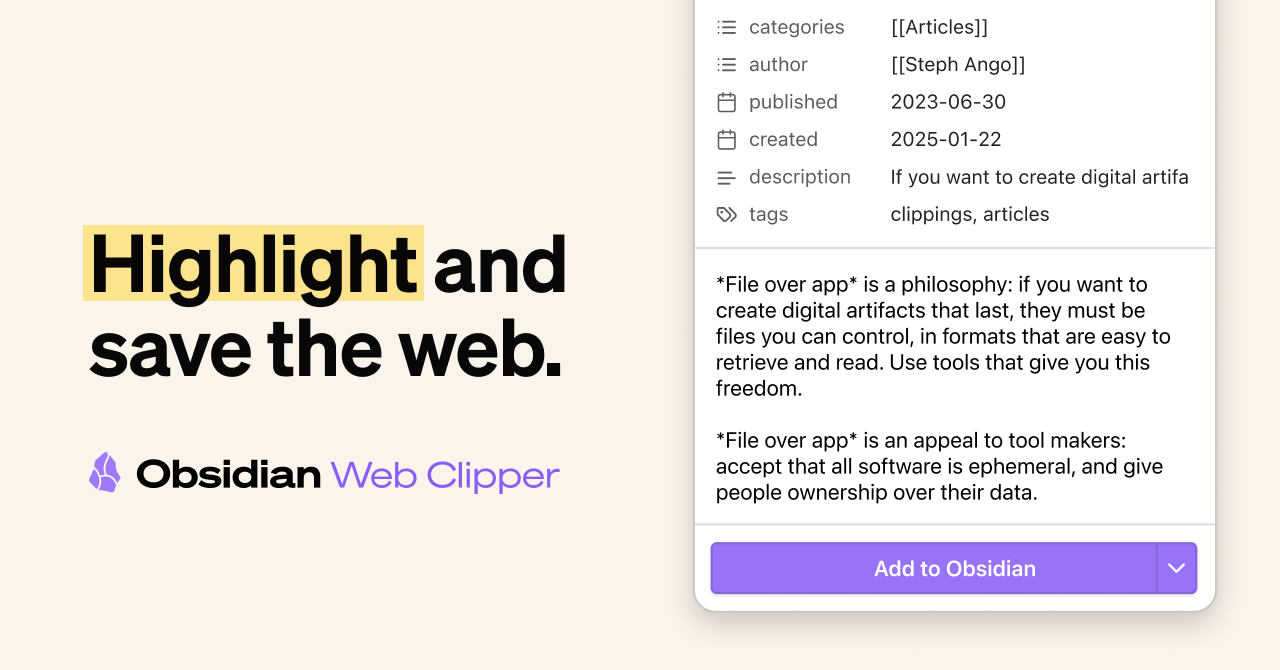
At that point, I saw no reason for me to continue.
Side quest: WebExtension
WebExtension is a pain in the rear to build. It lacks a mature ecosystem in comparison to the rest of JavaScript.
The only promising path was CRXJS which at the time, looked like it was about to be abandoned.
I did make a good proof of concept of what I was aiming for with Patchouli.
FWIW, This uses the SaaS version of Patchouli.
I know that WebExtension is going to be an important feature as even back then as most of the web was slowly gating itself with CloudFlare which prevents server-side scraping.
So, I needed a way to archive web pages as the user visits them so they archive what they actually read.
Today, very website is guarded by either CloudFlare or Anubis as the advent of AI scrapers made this the norm.
On a positive note, I’m happy to see that CRXJS is seemingly like it’s maintained again. I do hope that the WebExtension ecosystem gets better tooling, but I imagine the momentum is just isn’t there.
Conclusion
Patchouli X was my first honest foray into the development of desktop apps.
As we now have the benefit of hindsight, I can give you my recommendation for the web-centric route.
Tauri is great. You’re just wrapping your frontend into an exe and it gets the job done quite well.
Electron by comparison is thick in bad engineering decisions and decades of ignorance while Tauri has rich documentation and first-party ecosystem.
If you want a taste of it, figure out how to bundle, package, and distribute an Electron app with a sidecar for Windows, macOS, and Linux.
Tauri itself provides a good way to interact with the native world via Rust and it has a rich first-party plugin system which helps steers developers in the right ecosystem.
Not to mention, with v2, it might dethrone Capacitor for mobile apps.
If your goal is to create a good desktop app while using your existing skills from building web apps at work, I’d reach for Tauri.
As mentioned before, with the plugins ecosystem, I imagine you can get quite far without writing native code.
If you end up needing to, you’re not beholden to only Rust and you’d have the option of writing your own sidecar. This is especially useful if you want a strict separation between the “backend” and the “frontend” in your desktop apps.
If you want a TypeScript/JavaScript sidecar, you can package your backend with Bun as a single file executable.
Node.js has something similar, but it’s still in active development.
Considering how complete Bun is for everything (bun:sqlite, bun:ffi), I’d take Bun over Node.js anyday and you won’t know the pain of linking Node.js native modules on single file executables.